
-
 +86-15258555916
-
 [email protected]

 English
 中文简体
中文简体 русский
 Tiếng Việt
Water-Cooled Condensers: Types, Efficiency, and System Selection Guide
Content
A maintenance supervisor running a 400 kW cold store in a subtropical climate noticed that the packaged air-cooled units cycled deep into the night during July, while the water-cooled screw unit in the machine room held setpoint comfortably and logged lower compressor run hours. That difference comes down to one principle: water moves heat several times more effectively than air, and a water-cooled condenser exploits that to keep condensing temperature close to ambient wet-bulb conditions.
This guide explains how water-cooled condensers work, compares the three main designs, and translates the engineering data into practical selection decisions for food processing, cold-chain logistics, pharmaceutical, and industrial cooling projects.
How a Water-Cooled Condenser Works
A condenser rejects the heat absorbed by the evaporator plus the compressor work input. In a water-cooled condenser, hot refrigerant vapour from the compressor discharge enters the condenser and transfers heat to cooling water flowing through the heat exchanger. As the refrigerant loses heat, it desuperheats, condenses into liquid, and subcools slightly before leaving for the expansion device.
The cooling water follows one of three paths:
- Once-through: city or well water passes through the condenser and is discharged to drain.
- Recirculated with a cooling tower or fluid cooler: the same water is pumped around a loop and rejects heat to ambient air.
- Recirculated with a dry cooler for closed circuits that must avoid water evaporation.
Most industrial plants use the recirculated arrangement, because it gives the lowest and most stable condensing temperatures without wasting large volumes of water.
The Three Main Types of Water-Cooled Condensers
Manufacturers build water-cooled condensers in three principal configurations. Each suits a different capacity range and water quality profile.
Shell-and-Tube Condensers
Shell-and-tube condensers consist of a steel shell with a tube bundle running through it. Refrigerant occupies the shell side in most halocarbon and ammonia designs, while water passes through the tubes. Because the tube bundle can be removed and the tubes brushed or rodded out, this type is the first choice for large industrial systems and for plants with moderate water quality. Capacity spans from roughly 50 kW to several megawatts.
Brazed Plate Condensers
Brazed plate condensers are formed from a stack of corrugated stainless steel plates brazed together. Refrigerant and water flow in counter-current directions through alternating channels, producing very high heat-transfer coefficients in a fraction of the space. They are compact, lightweight, and efficient, but the narrow channels tolerate dirty water poorly, so they work best with clean recirculated water and adequate filtration.
Coaxial (Tube-in-Tube) Condensers
Coaxial condensers use a spiral inner tube inside a larger outer tube. One fluid flows through the inner tube, the other through the annular space. The compact helical shape is common in packaged chillers and heat pumps up to a few hundred kilowatts. They handle moderate water quality better than plate units, but cleaning a fouled coil is more difficult than opening a shell-and-tube bundle.
The table below compares the three designs in daily service.
| Property | Shell-and-tube | Brazed plate | Coaxial |
|---|---|---|---|
| Capacity range | 50 kW to several MW | 10 to 800 kW | 5 to 400 kW |
| Footprint per kW | Largest | Smallest | Intermediate |
| Fouling tolerance | Good | Low | Moderate |
| Cleanability | Excellent | Poor | Limited |
| Typical water source | City, well, tower | Clean filtered tower water | City or tower water |
For projects that need a condenser matched to an existing compressor rack, packaged industrial water-cooled condensers are available in the capacity range used by most cold stores and food plants.
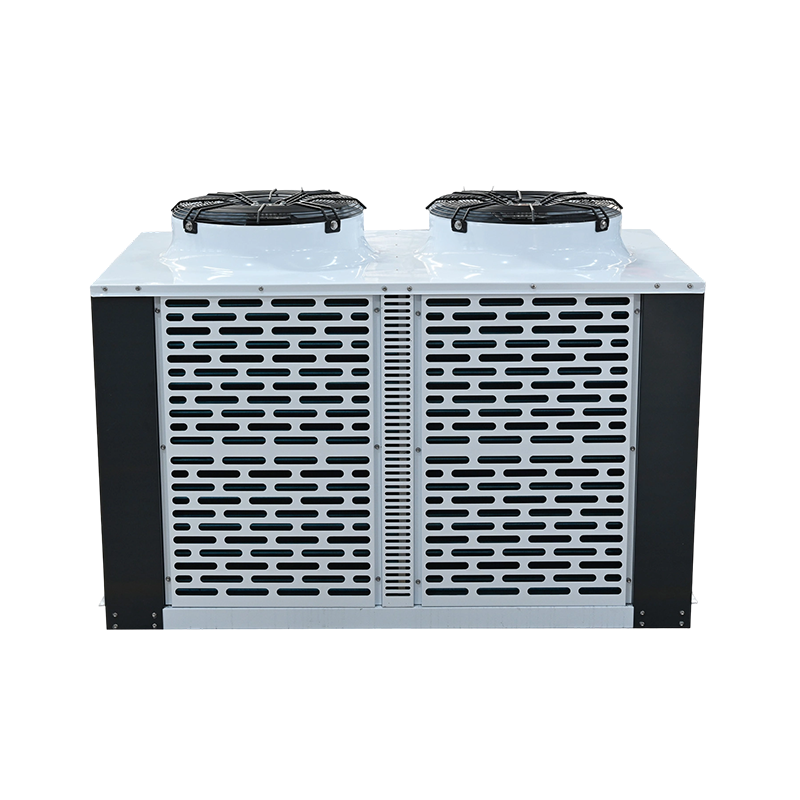
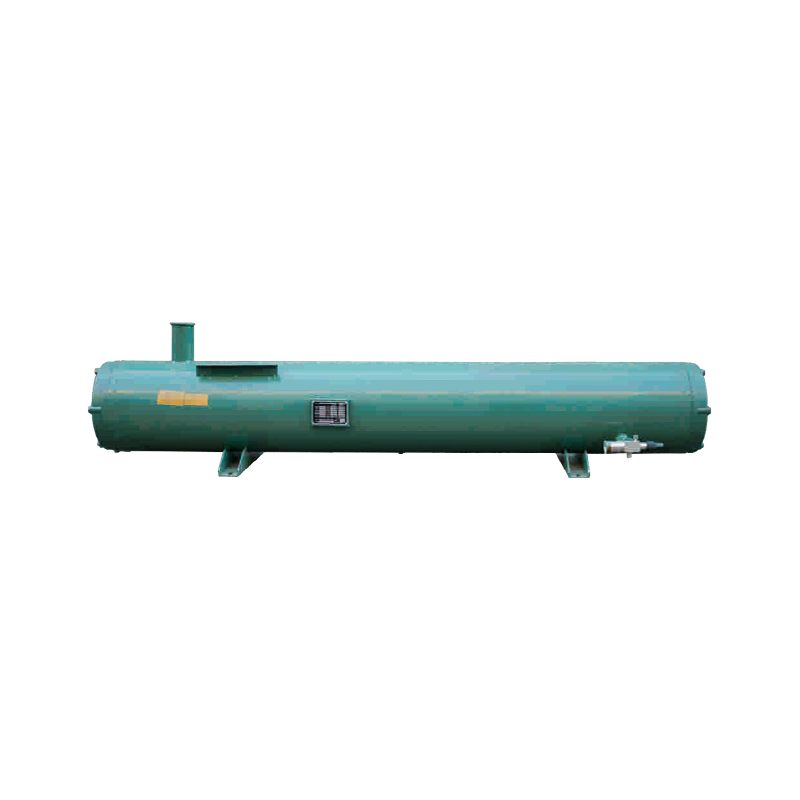 Industrial Water-Cooled Condenser for High-Load RefrigerationThis packaged condenser suits large-capacity refrigeration systems that need compact, efficient heat rejection. Unlike air-cooled units, it condenses closer to wet-bulb temperature, which lowers compressor power and improves stability in summer heat.View Product →
Water-Cooled Versus Air-Cooled: The Efficiency Difference
Air-cooled condensers reject heat at a temperature fixed by ambient dry-bulb temperature, typically 10 to 15 K above it. On a 38 °C afternoon that means condensing at 48 to 53 °C. Water-cooled condensers operate against wet-bulb temperature, typically 5 to 8 K above it. At a wet-bulb of 27 °C, condensing can stay near 32 to 35 °C even in summer heat.
Lower condensing temperature directly reduces compressor pressure ratio and power draw. As a rule of thumb, every 1 K reduction in condensing temperature improves system efficiency by about 2 to 3 percent. A water-cooled plant operating 10 to 15 K below an air-cooled equivalent can therefore cut compressor energy consumption by roughly 20 to 30 percent during peak load, while also producing more capacity.
Those gains come with trade-offs: water treatment, pump energy, cooling-tower fan energy, and higher first cost for the water loop. The decision depends on local water availability, climate, electricity price, and whether the plant runs at high load year-round.
| Factor | Air-cooled | Water-cooled with tower |
|---|---|---|
| Condensing reference | Dry-bulb temperature | Wet-bulb temperature |
| Typical condensing at 35 °C ambient | 46 to 52 °C | 31 to 36 °C |
| Compressor energy use | Higher | Lower, roughly 20 to 30 percent at peak |
| Water consumption | None | Makeup water for evaporation |
| Maintenance focus | Coil cleaning, fan drives | Water treatment, tower basin, fouling |
| Indoor space | Compact plant, outdoor coil | Condenser plus tower and pump space |
For a deeper look at the trade-offs, see our earlier analysis of the key advantages of air-cooled condensers over water-cooled designs. The choice is rarely absolute; it is a project-specific balance of energy, water, and capital cost.
Selection Criteria: What to Specify Before You Buy
Before selecting a water-cooled condenser, define the heat rejection duty, entering condenser water temperature, leaving condenser water temperature, and allowable pressure drop. These four numbers determine the correct size and configuration for any of the three designs.
- Heat rejection duty: evaporator load plus compressor heat input, often 1.25 to 1.35 times the refrigeration capacity on a single-stage plant.
- Condensing temperature: usually 30 to 40 °C for water-cooled plants; 35 °C with a 30 °C entering water temperature is a common starting selection.
- Water flow rate: calculated from the duty and the water temperature rise, commonly a 5 K design rise in tower loops.
- Fouling factor: a design allowance for scale and biofilm, typically 0.000044 to 0.000176 m2 K/W depending on water quality.
Fouling factor is where many purchases go wrong. A condenser sized with too low a fouling factor sheds capacity within months in hard-water areas. Copper or cupronickel tubes resist scaling better than plain steel, and stainless steel plate units are preferred where chlorides are high. If water quality is uncertain, do not let first cost override cleanability.
For complete packages, condensing units pair a water-cooled condenser with a screw or piston compressor and the necessary controls on a single base frame, which simplifies installation and commissioning.
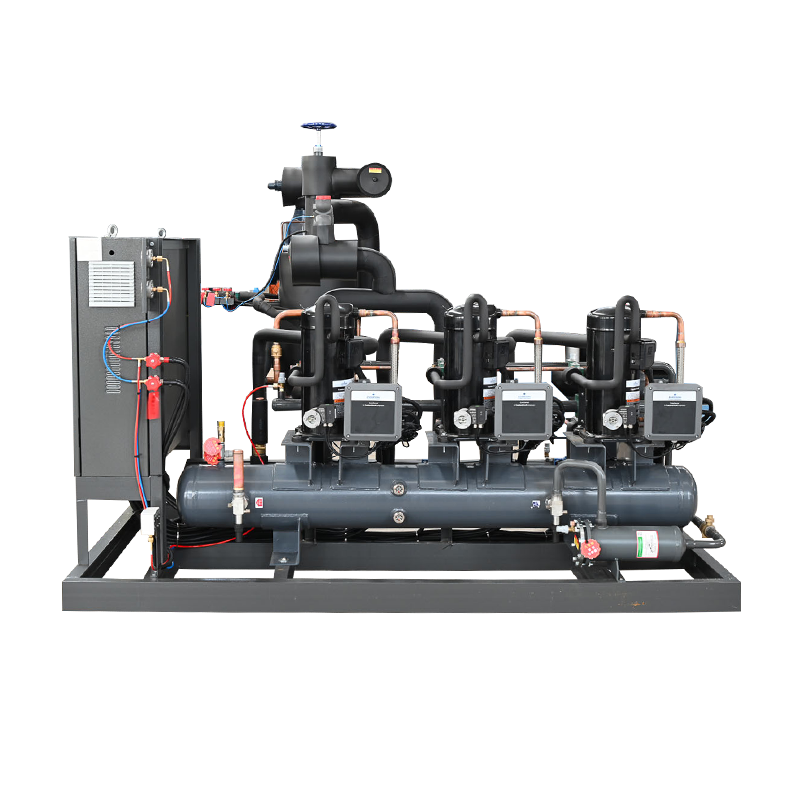
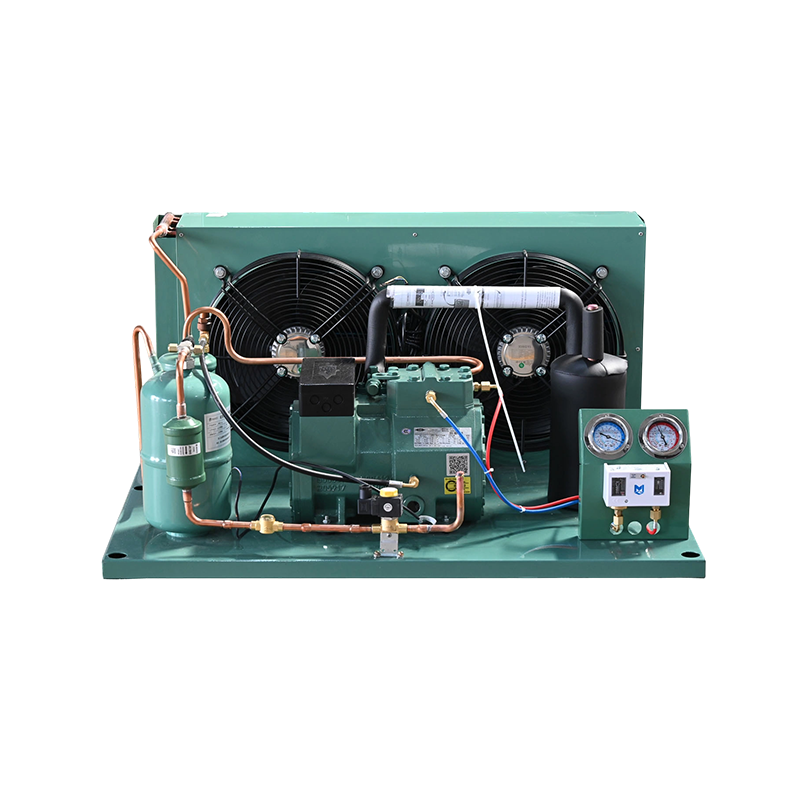 Bitzer Low-Temperature Screw Water-Cooled Condensing UnitA factory-assembled condensing unit with a semi-hermetic screw compressor, designed for steady operation at low evaporating temperatures. Ideal for cold stores and industrial processing where reliable capacity and easy maintenance are key.View Product →
Application-Driven Choices in Practice
Cold stores and food processing plants usually pick shell-and-tube condensers for central halocarbon or ammonia racks because they can be cleaned in place and last for decades. Pharmaceutical facilities tend to prefer brazed plate units on closed loops, where chemical water treatment keeps fouling negligible. Packaged chillers for process cooling commonly use coaxial condensers to keep the footprint small.
Climate matters as much as the industry. In hot, dry regions, a cooling tower delivers low wet-bulb temperatures and the energy savings are large. In coastal areas, airborne salt combined with tower carryover can corrode conventional tubes; a stainless steel plate condenser or a cupronickel tube bundle is a safer specification.
Water supply availability is the limiting constraint on many sites. Where water is expensive or scarce, an evaporative condenser or a matched air-cooled system with careful part-load control may deliver a better life-cycle cost than a water-cooled loop. The right answer depends on local utility tariffs, not on the type of business alone.
Energy, Water, and the Sustainability Picture
Because a water-cooled condenser keeps condensing pressure low, it also lowers compressor discharge temperature and improves oil and refrigerant condition. The combination of lower pressure ratio, better volumetric efficiency, and effective subcooling explains why water-cooled screw plants commonly report specific energy consumption of 0.25 to 0.35 kW per kW of refrigeration for medium-temperature duty, while equivalent air-cooled machines sit 15 to 25 percent higher.
Total equivalent warming impact combines direct refrigerant emissions with indirect CO2 from electricity. Every kilowatt-hour saved on the compressor helps the indirect side, and a water-cooled condenser's lower condensing temperature remains one of the simplest ways to reduce that indirect load. Tighter water management, including blow-down control, drift eliminators, and leak detection, addresses the main objection to water-cooled systems.
Cold-chain regulation and adoption of natural refrigerants are pushing the industry in this direction. More efficient heat rejection, tighter systems, and lower carbon intensity per tonne of stored product are becoming procurement requirements, as covered in our review of the green cold-chain transition and natural refrigerant adoption.
Manufacturers now offer water-cooled condensing packages that match these goals without complicating the plant design.
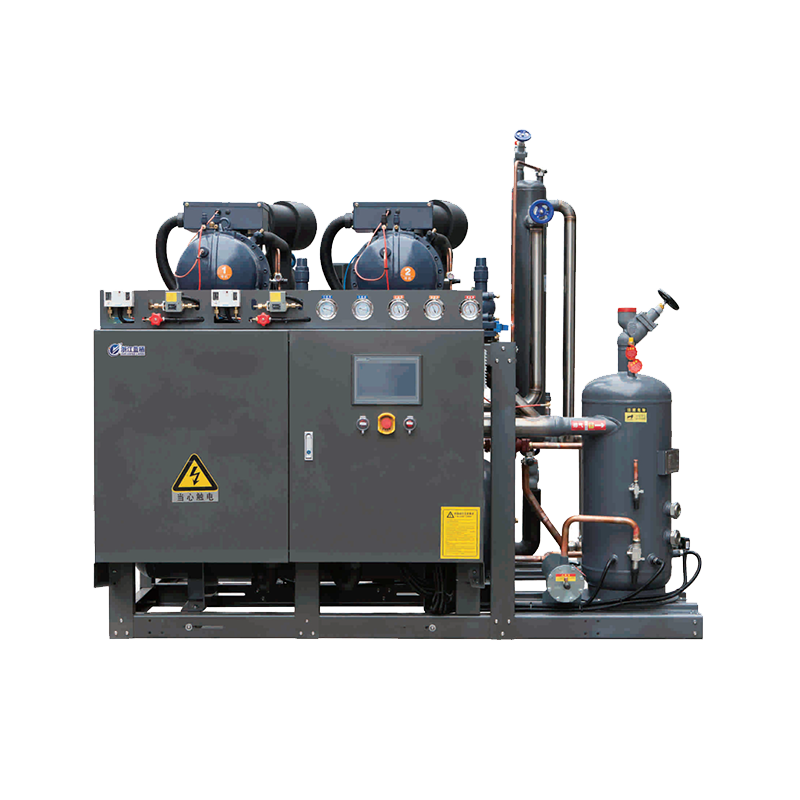 Hanbell Medium and High Temperature Screw Water Condensing UnitA fully integrated water-cooled condensing unit covering medium to high evaporating temperatures. It packages compressor, oil separator, receiver, and controls on one frame, reducing installation effort and floor space while supporting versatile cold storage applications.View Product →
Water-cooled condensers earn their place wherever condensing temperature governs annual energy cost. Start from the wet-bulb temperature of the site, select the condenser type that matches water quality and service access, and size with an honest fouling factor. Plants that do this routinely see lower compressor power, steadier capacity, and fewer high-pressure trips, which are the three results that matter most to anyone paying the electricity bill.


-
When a food-processing plant in a water-scarce region evaluates its refrigeration options, the cond...
READ MORE -
Air-cooled condensers (ACCs) offer a compelling and increasingly well-documented set of advantages o...
READ MORE -
A freezer warehouse holding -30°C rooms loses money quickly once summer heat drives condensing pres...
READ MORE -
The Operational Mandate of the Air-Cooled Condenser An air-cooled condenser is a direct dry cooling...
READ MORE -
A cold storage manager in a food plant once called us about a unit that could not pull a 200 square...
READ MORE -
When a food processor plans a new -18°C freezer, the first equipment decision is usually about the ...
READ MORE

- Email: [email protected]
- Phone: +86-15258555916
- Add: 301 Punan Avenue, Pukou Street, Shengzhou City, Shaoxing City, Zhejiang Province.China
Copyright © Zhejiang Lanxi Refrigeration Equipment Co., Ltd. All Rights Reserved.
浙ICP备2022034605号-1
 Custom Refrigeration Equipment Manufacturers
