
-
 +86-15258555916
-
 [email protected]

 English
 中文简体
中文简体 русский
 Tiếng Việt
Water-Cooled Condensing Units: Selection Guide for Industrial Refrigeration
Content
On a 38°C summer afternoon, a food processing plant in eastern China watched its air-cooled condensing unit trip on high head pressure four times within six hours. Evaporator temperature drifted two degrees above setpoint, and a batch of chilled product was rejected as a precaution. The coils had been cleaned the week before, so dirt was not the cause. The condenser was rejecting heat into air only a few degrees cooler than the refrigerant itself. A water-cooled condensing unit connected to a cooling tower would have held its condensing temperature steady all day.
Water-cooled condensing units are standard solutions for sites where water is available, where indoor installation is required, or where summer heat makes air-cooled operation inefficient. This article explains how they work, compares the three condenser designs on the market, and lists the site conditions and specification checks that separate a good purchase from a costly one.
How a Water-Cooled Condensing Unit Works
Every vapour-compression system follows the same path. The compressor raises the temperature and pressure of the refrigerant gas; the condenser removes heat and turns it back into a liquid; the expansion valve and evaporator absorb heat at the load. The condenser rejects both the evaporator load and the heat of compression, so its performance determines how hard the compressor must work.
An air-cooled condenser rejects this heat to ambient air. A water-cooled condensing unit rejects it to water from a cooling tower, city supply, well, or closed loop. Water absorbs heat far more effectively than air, so the condensing temperature stays lower and the compressor runs against a smaller pressure difference. That is why manufacturers position water-cooled units as the preferred option where air-cooled condensers are impractical, provided water is readily available.
Three Condenser Designs You Will Encounter
You cannot evaluate a water-cooled condensing unit without understanding its condenser. Three designs dominate, and each fits a different capacity range and water-quality situation.
Shell-and-Tube Condensers
Shell-and-tube condensers are the industrial workhorse. Refrigerant condenses in the shell while water flows through bundles of tubes inside. They handle large heat loads, tolerate poor water quality better than the other designs, and can be opened for mechanical cleaning. Most plant-level condensing units above roughly 100 kW use this construction.
Brazed Plate Condensers
Brazed plate condensers are compact and extremely efficient, with a minimal refrigerant charge. They dominate commercial duty and smaller industrial units. The narrow channels are sensitive to scale and debris, so clean water and proper filtration are mandatory.
Coaxial Tube-in-Tube Condensers
Coaxial condensers wrap one tube around another and flow water and refrigerant in opposite directions. They are simple, forgiving, and common on smaller packaged units where first cost and service simplicity matter more than maximum efficiency.
| Design | Capacity range | Efficiency | Fouling risk | Cleaning |
|---|---|---|---|---|
| Shell-and-tube | Large | Moderate | Low | Easy |
| Brazed plate | Small to medium | Very high | High | Difficult |
| Coaxial tube-in-tube | Small | Moderate | Medium | Moderate |
For projects that already have a compressor unit, the condenser selection matters as much as the compressor itself. A dedicated water-cooled condenser matched to the heat rejection load keeps condensing pressure where the compressor was designed to run.
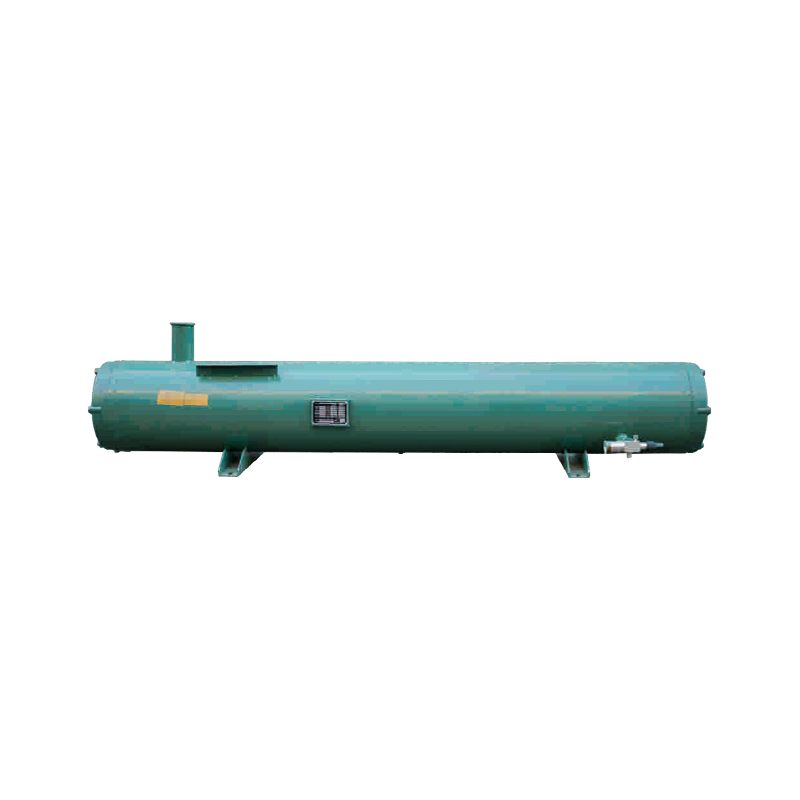 Water-Cooled Condenser for High-Load Industrial RefrigerationThis water-cooled condenser suits projects needing efficient heat rejection in a compact footprint, especially where condensing temperature and energy consumption are critical. It is positioned as a key component to match compressor design pressure.View Product →
Why Lower Condensing Temperature Matters
The condensing temperature sets the compressor pressure ratio, and the pressure ratio sets energy consumption. A water-cooled unit typically condenses at 35–42°C on a hot day. An air-cooled unit at the same site may run at 45–55°C. The difference is not academic.
Each 1 K reduction in condensing temperature lowers compressor power by roughly 2–3%. A unit operating 10 K cooler cuts compressor electricity by 10–15% while producing more cooling capacity at the evaporator. The compressor also discharges at a lower pressure, which reduces bearing load and oil deterioration.
This is why the practical comparison is not unit price but seasonal energy performance. Air-cooled performance falls exactly when the plant needs it most: on the hottest afternoons. Water-cooled performance remains stable.
| Operating parameter | Air-cooled unit | Water-cooled unit |
|---|---|---|
| Condensing temperature | 45–55°C | 35–42°C |
| Compressor power draw | Higher | Lower by 10–15% |
| Cooling capacity in hot weather | Falls as ambient rises | Stable |
| Indoor installation | Not practical | Practical |
| Noise at roof level | Fan noise | Pump noise only |
| Water consumption | None | Required |
Water-Cooled or Air-Cooled: How to Choose
Start with site conditions, not first cost. A water-cooled system needs a cooling tower or another water source, a pump set, piping, and water treatment. That initial cost usually exceeds a simple rooftop air-cooled unit. The payback comes from lower energy bills, fewer high-pressure trips, longer compressor life, and the ability to recover waste heat.
Choose water-cooled when the unit must be installed indoors; when ambient summer temperatures are high enough to degrade air-cooled performance; when noise around the building must be low; when a cooling tower or water circuit already exists; or when waste heat can be reused for boiler feed pre-heating, washing water, or space heating.
Choose air-cooled when water is scarce or expensive, when the site cannot operate a water-treatment program, or when the system is small, simple, and runs only part of the year. For a detailed comparison of the trade-offs, read the key advantages of air-cooled condensers over water-cooled.
What to Verify Before You Buy
A water-cooled condensing unit is expected to last 15–20 years. Specification errors are difficult and expensive to correct later, so check five points before ordering.
- Compressor brand and service network. The compressor decides performance, efficiency, and service life. Lanxi builds units around internationally recognised brands such as Bitzer, Refcomp, Hanbell, Fusheng, and Frascold, which provides documented performance data and realistic spare-parts logistics. Avoid unbranded compressors unless the price difference is enormous and you accept the parts risk.
- Design water inlet temperature. Condensing depends on entering water temperature. Confirm the cooling tower or water source can actually deliver the rated inlet temperature during summer peak load.
- Water quality. Hard water, algae, and debris raise condensing pressure within weeks. Include filtration, chemical treatment, or an intermediate heat exchanger before the condenser.
- Refrigerant and temperature range. A −35°C freezer needs a screw or two-stage-capable solution; a +5°C cold room can use a single-stage piston unit. Confirm the unit matches the design evaporation temperature, not just the nominal capacity.
- Controls and safeties. High-pressure protection, oil level control, and communication with plant PLC or BMS systems avoid avoidable downtime.
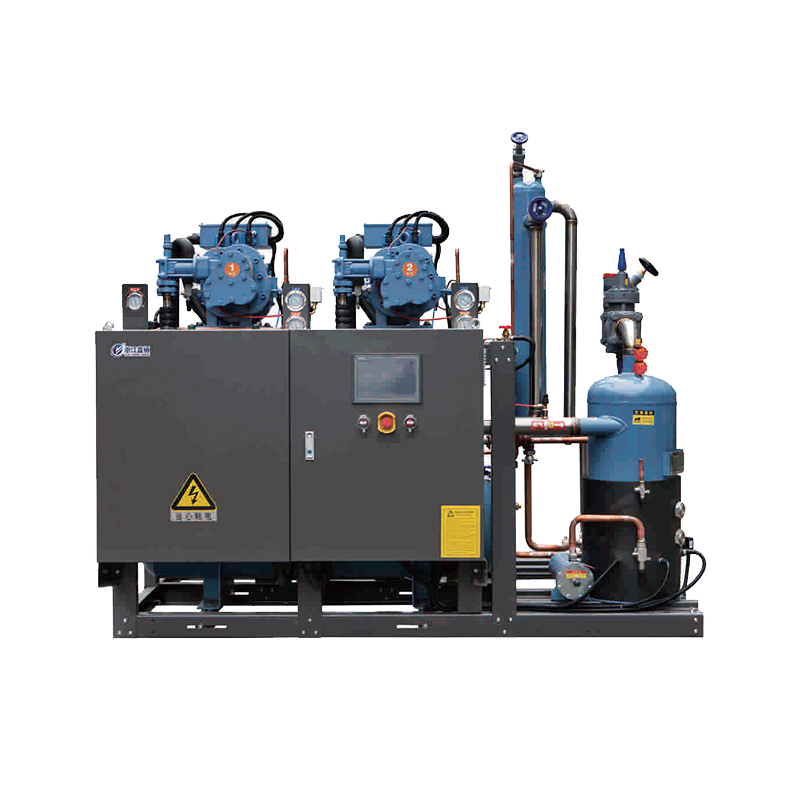
For low-temperature stores, the Bitzer low-temperature screw water-cooled condensing unit couples one of the most widely used screw platforms in cold storage with a water-cooled condenser in a single packaged unit.
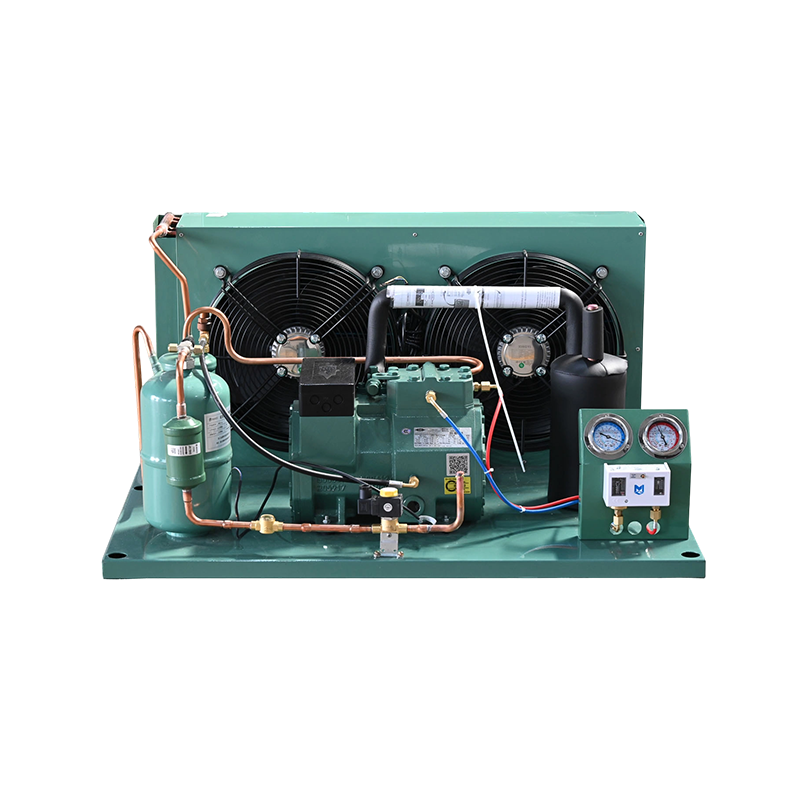 Bitzer Low-Temperature Screw Water-Cooled Condensing UnitThis packaged unit pairs a Bitzer screw compressor with water cooling for low-temperature cold storage. It is highlighted after discussing how the condenser influences system performance, making it a practical choice for reliable low-temperature operation.View Product →
The same evaluation logic applies at component level. Review the screw and piston condensing unit series to see how compressor options, temperature ranges, and water-cooling configurations are combined in practice.
Where Water-Cooled Condensing Units Earn Their Keep
In food processing, cold chain, pharmaceutical, and chemical plants, water-cooled condensing units are common because process water is often available and temperature stability is a contract requirement.
- Food processing: brine and process-water chilling, cooked product cooling, and cold storage of raw materials. Recovered heat can cover sanitation-water demand.
- Cold chain logistics: distribution centres need quiet, indoor heat rejection without roof penetrations that compromise the building envelope.
- Pharmaceutical and chemical: medium-temperature storage that cannot tolerate spikes even during peak summer load.
- Freezing and cold storage: low-temperature screw units hold evaporation temperature stable while doors open and loads peak.
On the medium-to-high-temperature side, the Hanbell medium and high temperature screw water-cooled condensing unit is a practical choice for process cooling and ingredient storage where compressor power must stay low across a wide load range.
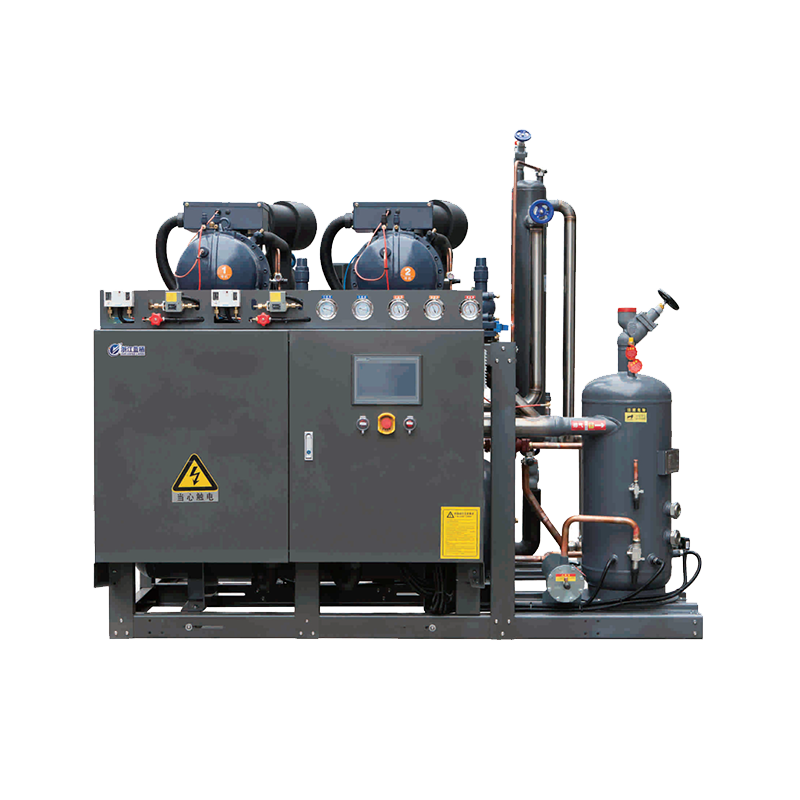 Hanbell Medium and High Temperature Screw Water Condensing UnitThis integrated unit covers medium to high evaporating temperatures and includes key components like an oil separator and controller. It appears in the discussion because it addresses process cooling and ingredient storage while keeping compressor power low.View Product →
Water cooling is not the right answer for every site, but it fixes problems that air cooling cannot: high ambient temperature, indoor placement, noise limits, and wasted heat. The decision is simple on paper: verify water availability and quality, confirm the rated water inlet temperature can be met, choose a compressor brand with proven support, and build the system so the condenser can be cleaned. Facilities that respect these rules get stable temperatures and lower energy bills for the full life of the unit.



-
What Is an Industrial Air Cooler and How Does It Work in a Refrigeration System? Picture a medium-s...
READ MORE -
A maintenance supervisor running a 400 kW cold store in a subtropical climate noticed that the pack...
READ MORE -
When a food processor plans a new -18°C freezer, the first equipment decision is usually about the ...
READ MORE -
Condenser: The Core Heat Rejection Component of All Refrigeration & HVAC Systems Every functiona...
READ MORE -
A cold storage manager in a food plant once called us about a unit that could not pull a 200 square...
READ MORE -
Complete Condenser Selection Guide: Choose the Right Condenser for Industrial & HVAC Systems A c...
READ MORE

- Email: [email protected]
- Phone: +86-15258555916
- Add: 301 Punan Avenue, Pukou Street, Shengzhou City, Shaoxing City, Zhejiang Province.China
Copyright © Zhejiang Lanxi Refrigeration Equipment Co., Ltd. All Rights Reserved.
浙ICP备2022034605号-1
 Custom Refrigeration Equipment Manufacturers
