
-
 +86-15258555916
-
 [email protected]

 English
 中文简体
中文简体 русский
 Tiếng Việt
How to Evaluate Refrigeration Equipment Manufacturers Before Making a Purchase
Content
A procurement manager at a frozen food plant in Shandong recently placed three quotations side by side. On paper, the refrigeration equipment manufacturers looked identical: similar capacity, comparable coil area, and every unit built around a stated international compressor. Six months later, only one system was still pulling down to temperature without repeated capacity loss. The difference was never visible in the brochure. It was buried in component selection, system integration, and whether the manufacturer took responsibility for the entire installation.
The reliable suppliers are not the ones with the longest product lists. They are the ones who can explain, prove, and support every major component in the system. That standard guides how we build equipment at Zhejiang Lanxi Refrigeration Equipment Co., Ltd., and it is the standard you should apply when evaluating any factory.
What Separates a Refrigeration Equipment Manufacturer from an Assembler
The compressor is the heart of any refrigeration system, and the manufacturer's choice of compressor tells you more than any capacity figure. Established names such as Bitzer, Hanbell, Fusheng, Refcomp, and RFC have published performance curves, service networks, and decades of field data behind them. When a manufacturer specifies these rather than anonymous or private-label compressors, you gain documented efficiency data, available spare parts, and predictable maintenance intervals.
The second difference is integration. A genuine manufacturer designs the evaporator, condenser, and compressor unit as one matched system. Coil surface, fan airflow, defrost intervals, and liquid distribution all affect real-world energy use. A factory that builds the complete set rather than bolting together purchased parts can take responsibility for how the whole system performs together.
Quality management matters as much as the components. Look for a factory that can show its production process, testing steps, and inspection records. In our own facility in Shengzhou, every unit is assembled in a controlled workflow and tested before shipment, because we know a leak or a miswired controller costs more in a cold room than it ever saves on the production floor.
Map the Equipment to Your Cold Chain Stage
A refrigeration project is a chain: the evaporator removes heat from the space, the condenser rejects that heat to the outside, and the compressor unit moves refrigerant between them. All three links must be equivalent in quality, or the weakest one limits the entire system. Our complete product lineup covers these links with matching designs.
On the evaporator side, unit coolers, often called air coolers or cold blowers, must match the room shape and temperature. Our DD, DJ, and DL series cold blowers serve different temperature bands and room sizes. Dual-side discharge models distribute air more evenly in wider cold stores, while floor-mounted units suit high-bay warehouses. In low-temperature rooms below -25°C, water-defrosting cold blowers reduce the energy penalty of electric defrost and keep production running.
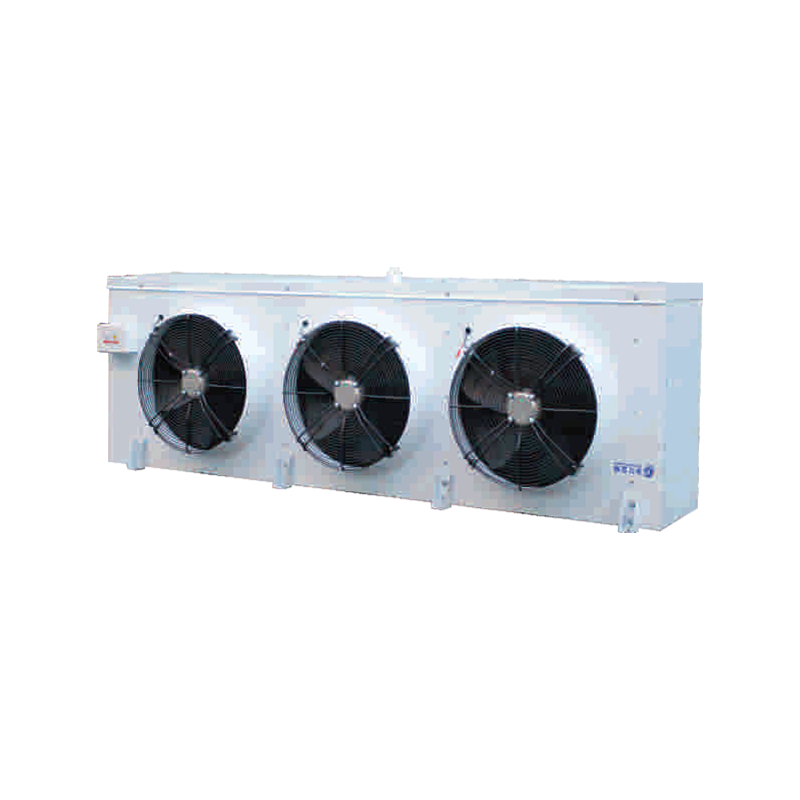 DD Series Cold Blower for Freezing and Cold StorageThis unit cooler suits low-temperature rooms and cold stores, with corrosion-resistant casing and efficient defrosting to maintain stable operation below -25°C.View Product →
On the heat rejection side, the condenser choice follows your site's conditions. Air-cooled condensers such as the FNH, FNU, FNV, and FNV B series are the most common because installation is simple and there is no water consumption. Evaporative condensers use water evaporation to lower condensing temperature, which cuts compressor power in warm climates. Water-cooled condensers fit plants that already operate cooling towers. Each type carries a different first cost, operating cost, and maintenance profile.
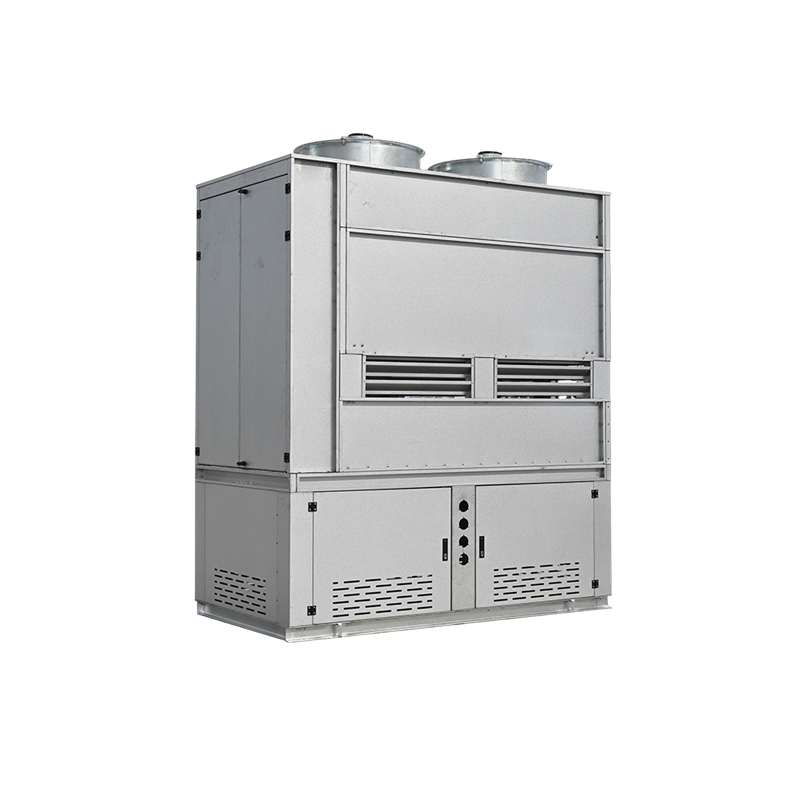 Evaporative Condenser with Combined Air-Water CoolingFor warm climates, this condenser lowers condensing temperature and cuts compressor power while reducing water use, offering energy savings and easy maintenance.View Product →
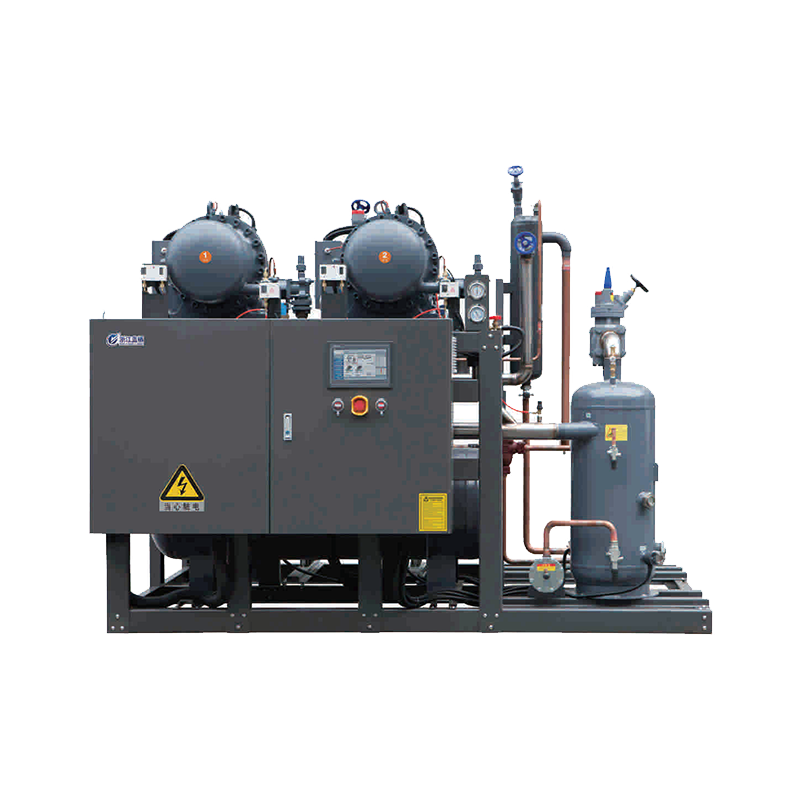
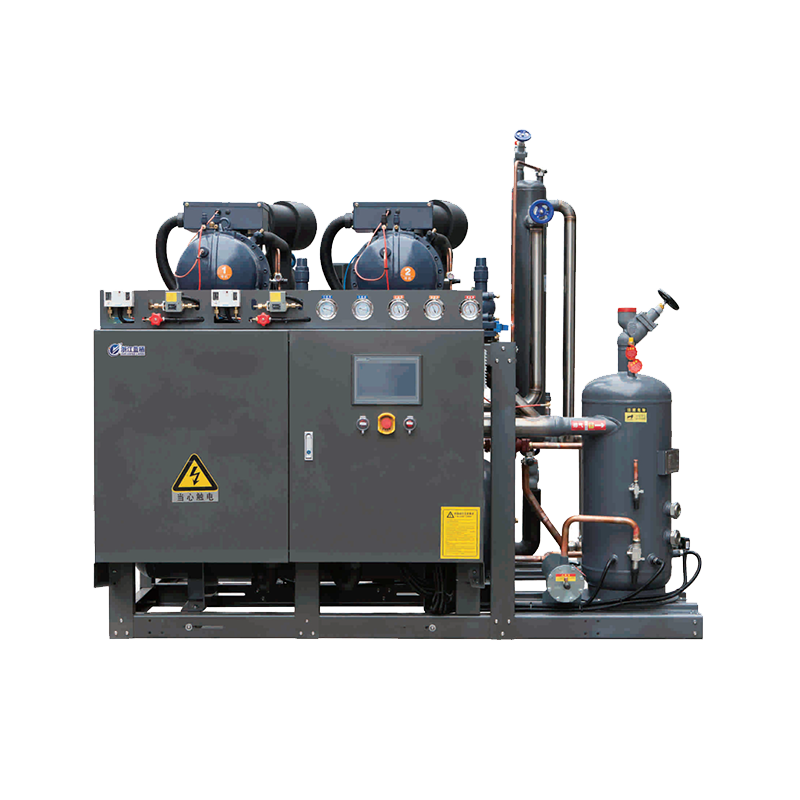
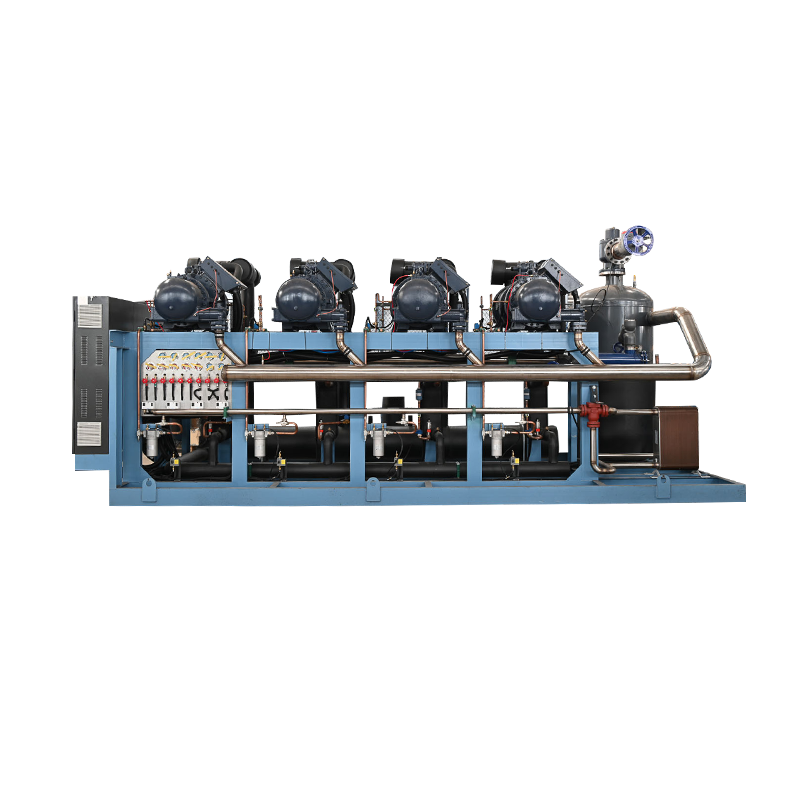
Between the evaporator and condenser sits the compressor unit. Screw compressor units handle continuous high loads and large cold rooms efficiently. Piston parallel units provide multiple capacity steps, better part-load flexibility, and built-in redundancy for facilities where downtime is not an option. Our screw and piston unit series also includes barrel pump units, which circulate liquid refrigerant positively to evaporators in large distributed systems.
Screw or Piston: Let the Load Decide
Selecting the compressor technology is the decision that most affects both capital cost and annual energy bills. Screw units earn their place in large cold storage rooms and process loads that stay high for many hours, because they produce large capacity in one compact package and hold efficiency well at full load. Piston units with multiple compressors in parallel remain attractive for medium installations, fluctuating loads, or operations that need one compressor to keep running while another is serviced.
Temperature band changes the optimal choice as well. For medium-to-high temperature work, such as ripening rooms and refrigerated processing areas from around -5°C to +10°C, piston units with multiple steps control precisely without short-cycling. For low-temperature duty at -25°C or below, a screw unit matched to a correctly sized condenser often delivers better year-round efficiency. We explain these trade-offs in detail in our screw compressor unit versus piston compressor unit comparison.
Whatever technology you lean toward, ask the manufacturer to calculate the system for your actual ambient temperature, not a temperate-average assumption. A unit sized for a 40°C summer day will behave very differently from one sized at 25°C.
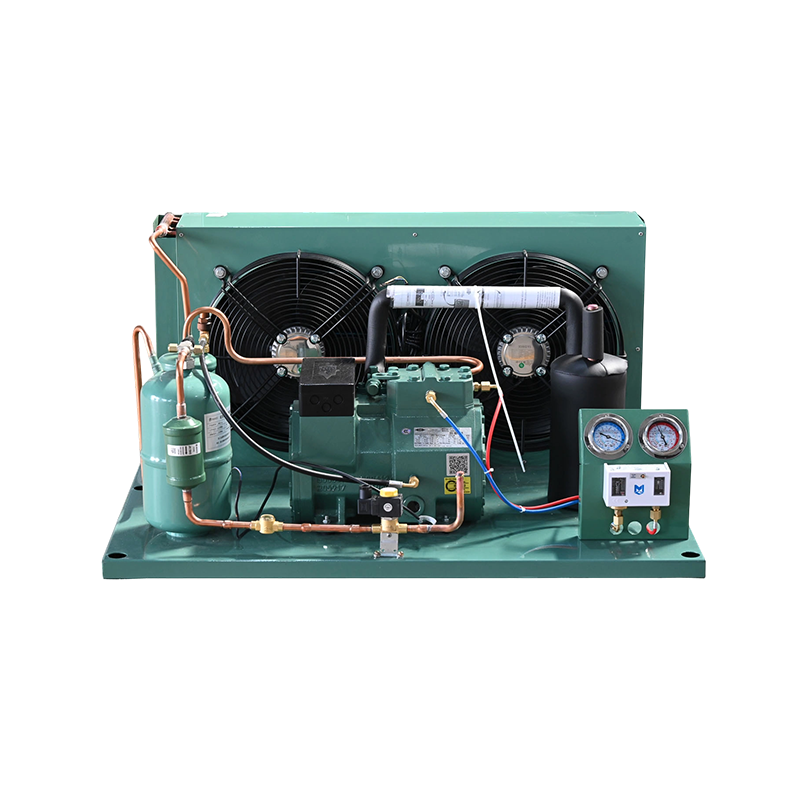 Bitzer Screw Unit for Industrial RefrigerationA high-efficiency screw compressor unit with oil management and safety controls, designed for continuous loads in cold storage and food processing.View Product →
What the Spec Sheet Does Not Show
Every manufacturer publishes nominal capacity. The valuable information is how the equipment behaves under real operating conditions: defrost frequency, fan heat added to the room, oil return in long pipe runs, ambient peaks, and partial-load efficiency. These factors decide your monthly energy bill and how often service technicians visit your site.
The application table below reflects the configurations we most often recommend for the industries we serve.
| Application | Typical Temperature Range | Recommended Configuration |
|---|---|---|
| Food processing | -35°C to -10°C | DD or DL air coolers, low-temperature piston or screw units |
| Cold chain logistics | -25°C to +5°C | Modular air coolers, medium-to-low temperature condensing units |
| Pharmaceutical and chemical | +2°C to +8°C, with some -20°C storage | Precise temperature control, redundant parallel piston units |
| Frozen storage | -35°C to -25°C | Low-temperature screw units, evaporative condensers, water-defrost air coolers |
Notice how the same manufacturer can supply very different combinations. That range matters, because a supplier with only one product category tends to optimize that product in isolation, leaving the rest of the system to be matched by the contractor or the buyer.
Customization and Long-Term Support
Cold storage projects are rarely identical, and that is why our engineering approach starts with the customer's requirement rather than a catalog. We design equipment solutions, plan the project layout, and provide complete system solutions, from a single cold room to a multi-temperature distribution center. Compressor sets can be built around the brand you already use: Bitzer, Hanbell, Fusheng, Refcomp, or RFC, among others, so your maintenance team does not need to learn a new platform.
Support is measured after the sale, not before it. A dependable manufacturer supplies dimensional drawings, pressure and wiring diagrams, and refrigerant charge guidance. For export customers, we prepare documentation in English, Chinese, Russian, and Vietnamese, which removes a frequent source of friction in international projects.
Questions to Ask Before You Order
- Ask for the exact compressor brand and model, not a general "branded compressor" promise.
- Request coil surface and airflow calculations for your real room conditions.
- Confirm the defrost method: electric, hot gas, or water, and what it costs to run.
- Check refrigerant compatibility if you plan to move to lower-GWP refrigerants such as R448A, R449A, or R290.
- Request dimensional drawings and service access details before you pour the equipment platform.
- Verify lead time, delivery terms, and spare parts support in writing.
Choosing among refrigeration equipment manufacturers becomes simpler once you look past the capacity data. Confirm which compressor is inside, check that the evaporator, condenser, and compressor are designed as one matched system, and ask for performance data calculated against your own site conditions. A manufacturer who can answer those questions with drawings, calculations, and test records is the one who will support you when the room temperature matters most.
-
Manufacturer Evaluation The manufacturers worth shortlisting are the ones that build their own com...
READ MORE -
High-quality refrigeration equipment is the core foundation of reliable cooling solutions for moder...
READ MORE -
Located in Shengzhou City, China, we are a professional manufacturer specializing in R&D, produc...
READ MORE -
Walk into a cold storage room and feel the air near the door. If one corner is warmer than another,...
READ MORE -
While searching for a evaporator and condenser manufacturer, Lanxi Refrigeration is certainly worth ...
READ MORE -
A cold storage manager in a food plant once called us about a unit that could not pull a 200 square...
READ MORE

- Email: [email protected]
- Phone: +86-15258555916
- Add: 301 Punan Avenue, Pukou Street, Shengzhou City, Shaoxing City, Zhejiang Province.China
Copyright © Zhejiang Lanxi Refrigeration Equipment Co., Ltd. All Rights Reserved.
浙ICP备2022034605号-1
 Custom Refrigeration Equipment Manufacturers
