
-
 +86-15258555916
-
 [email protected]

 English
 中文简体
 русский
 Tiếng Việt

Air-Cooled Condenser Guide: Sizing, Selection, and Installation Rules for Cold Rooms
Content
- 1 What an Air-Cooled Condenser Does, and What It Is Not
- 2 The Numbers That Decide Whether It Works
- 3 Where Air Cooling Wins, and Where It Does Not
- 4 Specification Checklist Before You Order
- 5 Site and Installation Details That Decide Real Performance
- 6 Maintenance and the One Number to Watch
- 7 Matching the Unit to the Plant
A 500-tonne cold store on an inland site has no dependable water supply, so the condenser decision is already half made: heat goes to air. What actually decides whether the plant holds temperature on the hottest afternoon of the year is not the choice of an air-cooled condenser but two numbers fixed months earlier — the design ambient you commit to, and the condensing temperature you allow above it.
The short version: pick a design dry-bulb 3–5 K above the local summer extreme, accept a condensing temperature 10–15 K above that, and treat airflow clearance and coil access as design requirements rather than installation details. Model, fan count, and materials all follow from those three decisions.
What an Air-Cooled Condenser Does, and What It Is Not
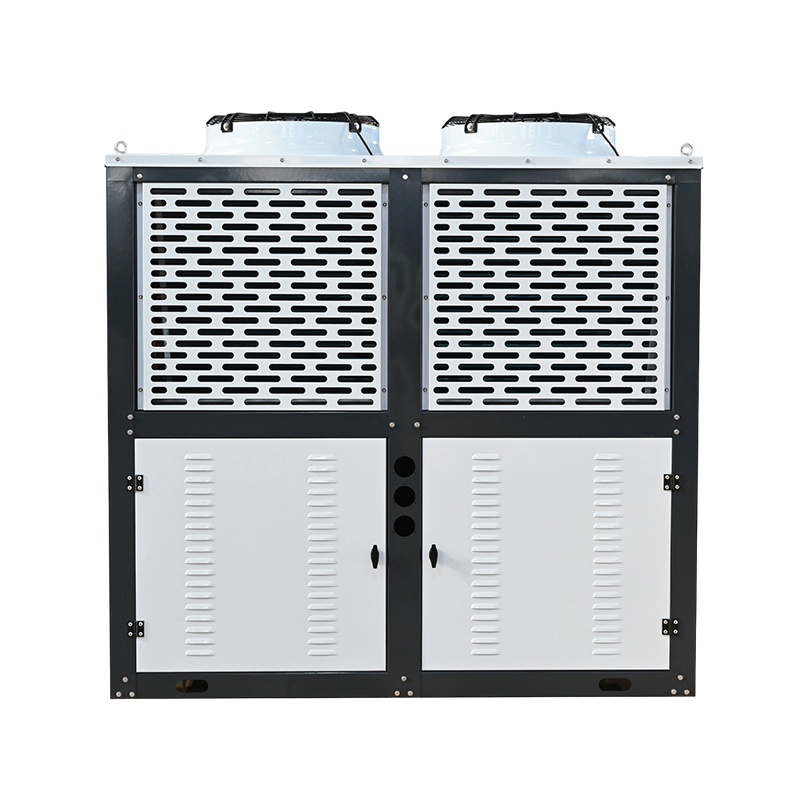
Hot discharge gas from the compressor gives up its latent heat to ambient air pulled across finned tubes by axial fans. The refrigerant leaves as liquid, usually with a few kelvin of subcooling, and drains to the receiver. No water, no cooling tower, no plume, no blowdown. The unit is a heat exchanger plus a fan array plus a frame, and its performance depends entirely on the air temperature and how clean the fins are.
Three components do most of the work: the finned tube bundle, the axial fans with their venturi hoods, and the motor and drive arrangement. Copper tubes with aluminium fins cover most halocarbon systems; stainless or coated bundles come into play where corrosion or ammonia demands it.
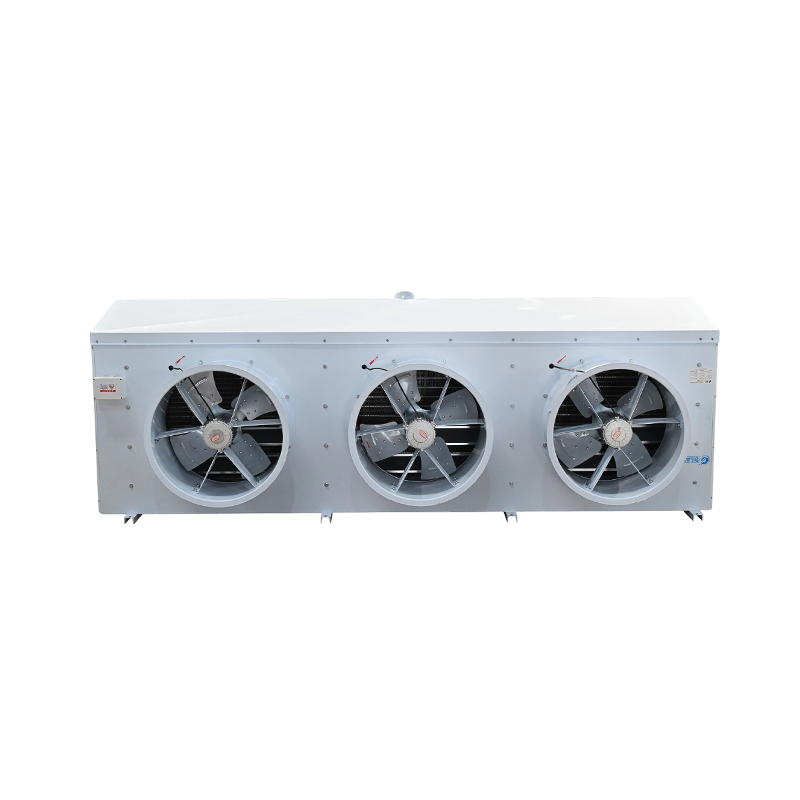
It is not the same device as an air cooler. An air cooler sits inside the cold room absorbing heat from the stored product; a condenser rejects that heat outdoors. The two are sized together but bought separately, and confusing them in a specification is a common and expensive mistake — our guide to air-cooled condensers and industrial air coolers sets out the difference in detail.
It is also not an evaporative condenser. An evaporative unit sprays water over the bundle and uses evaporation to reach a condensing temperature much closer to the wet-bulb, which in a dry climate can be 5–8 K lower than a dry condenser manages. The trade is water treatment, drift, and a wetted surface that needs managing year round.
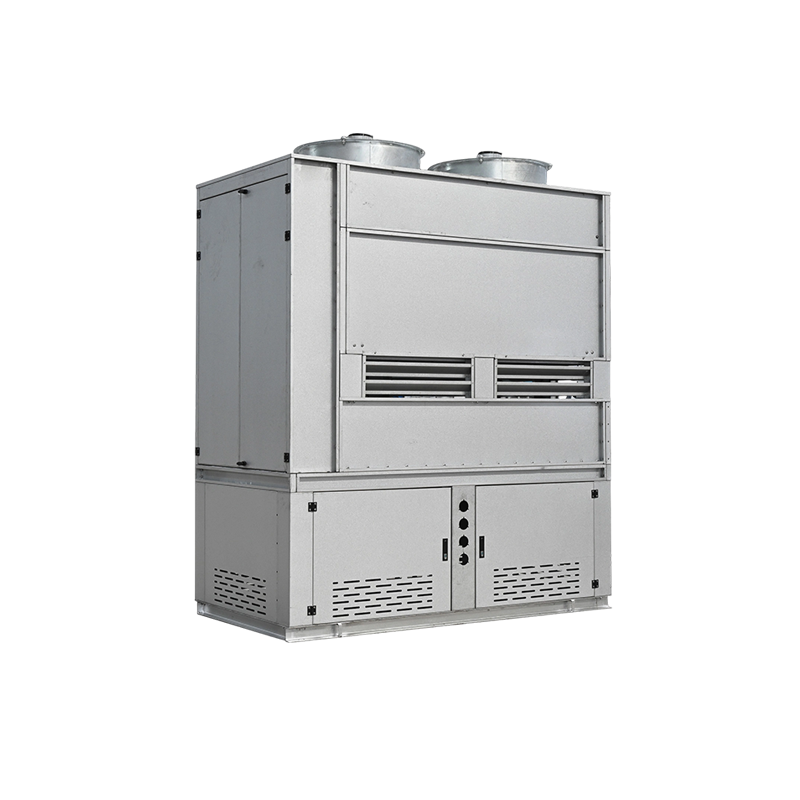 Evaporative Condenser for Industrial Refrigeration and HVACCombines sprayed water, air, and PVC packing to lower condensing temperatures; suited to industrial refrigeration and large commercial cooling where water treatment is managed.View Product →
The Numbers That Decide Whether It Works
Three temperatures govern everything: the design dry-bulb, the condensing temperature, and the pressure ratio the compressor then has to work against. Every kelvin added to the condensing temperature costs roughly 2–3 percent in compressor power, and every kelvin of margin costs coil surface. That is the whole economic argument in one sentence.
Design ambient should come from a weather file, not from memory. Take the summer dry-bulb exceeded about 0.4 percent of the year and add 3–5 K for site effects: a roof surrounded by dark asphalt, a prevailing wind that recirculates discharge air, or a future building next door. Projects that skip the adder usually discover it in July.
Fan energy is the second number people underestimate. Fans on a dry condenser typically draw around 1.5–3 percent of the heat they reject, which sounds small until you notice that a unit selected tight on surface area runs its fans flat out for weeks. Extra face area buys lower fan speed, lower noise, and a lower condensing temperature at once. Above roughly 1,000 m altitude, ask for a corrected selection rather than scaling capacity by rule of thumb, because air density falls and a fan moving a fixed volume moves less mass.
Indicative condensing temperature above design dry-bulb
Typical design rules of thumb; confirm against the actual selection at your site conditions.
For halocarbon plants, the FNH and FNU series cover the common capacity bands, while FNV and FNVB configurations suit roof layouts where a V-shaped or low-profile bundle fits better than a flat one.
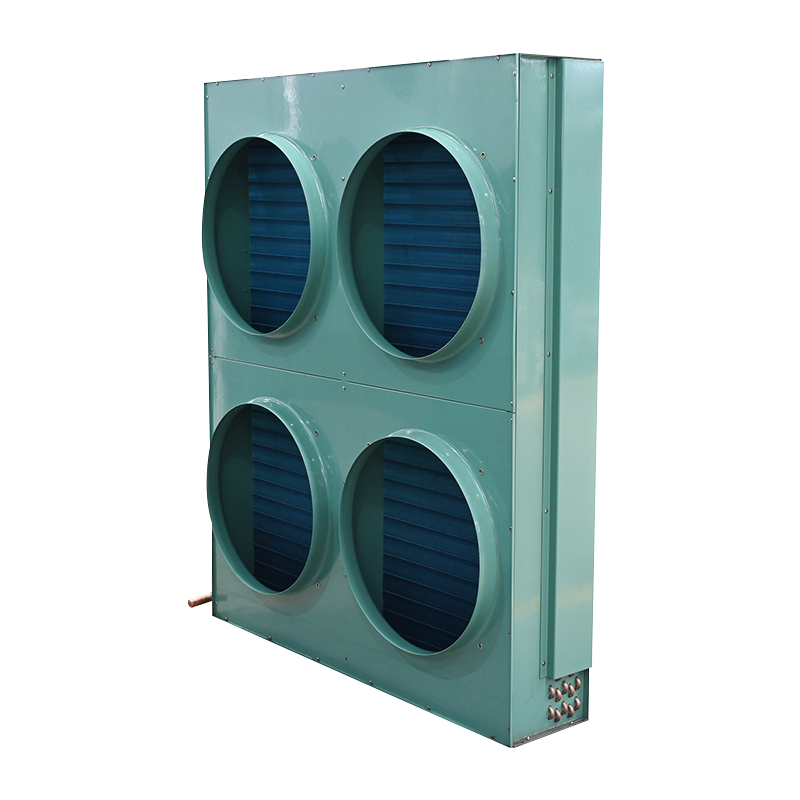 FNH Series Air-Cooled CondenserCovers 7.6–57.4 kW with copper tubes, aluminum fins, and multiple fan sizes; a practical fit for halocarbon refrigeration and air-conditioning systems.View Product →
Where Air Cooling Wins, and Where It Does Not
Air cooling is the default in these situations:
- Water is scarce, expensive, or regulated, and a tower would need treatment chemicals and blowdown permits.
- Winters drop below freezing, where a wet tower needs heat tracing and freeze protection.
- The plant runs seasonally, so a dry system can idle without water management.
- Permitting favours no plume and no visible vapour above the roofline.
- The unit sits at grade or on a roof with unobstructed air on at least two sides.
It struggles when the design dry-bulb is high and the process needs a low condensing temperature, and when space is tight, because a dry condenser needs far more face area than a water-cooled shell-and-tube for the same duty. Dusty or lint-laden air is the other limit: fin cleaning becomes a weekly task rather than a seasonal one.
Specification Checklist Before You Order
Most condenser problems trace back to a value that was never written down. Fix these in the purchase specification, and ask the supplier to confirm each one against their selection software.
| Parameter | Typical target | Why it matters |
|---|---|---|
| Design dry-bulb | 0.4 percent summer extreme plus 3–5 K | Caps worst-case condensing pressure |
| Condensing temperature | Ambient plus 10–15 K | Sets discharge pressure and compressor power |
| Face area and fan speed | Enough area to keep tip speed low | Cuts fan energy and night-time noise |
| Fin pitch | Wider spacing on dusty sites | Keeps cleaning practical |
| Intake clearance | At least one fan diameter | Avoids recirculation and capacity loss |
| Subcooling | 3–5 K at coil outlet | Protects expansion valve and liquid line |
| Bundle material | Coated aluminium or stainless where needed | Corrosion is the main lifetime limiter |
| Low-ambient control | Fan speed, fan cycling, or flooding | Holds head pressure through winter |
Site and Installation Details That Decide Real Performance
Recirculation is the quiet killer. If hot discharge air finds its way back to the intake because of a wall, a parapet, an adjacent unit, or a prevailing wind, the unit effectively sees a higher ambient than the design figure. Allow one fan diameter of clear space on the intake side, space units so their plumes do not merge, and orient the discharge away from the summer wind where the layout permits.
Piping matters as much. Long liquid lines without subcooling flash gas in the expansion valve and cost capacity that no condenser selection can recover. Insulate the liquid line, size the discharge line for a pressure drop you can live with, and remember that every bar of drop is compressor work you paid for and then discarded.
Winter operation needs a plan. A dry condenser can pull condensing pressure low enough to starve the expansion valve and trip low-pressure controls. Fan cycling, variable-speed fans, or a held-back arrangement keep head pressure stable; the right choice depends on how cold the site gets and how many fans the unit carries.
Maintenance and the One Number to Watch
Coil fouling is progressive and invisible until it is expensive. A dust film of a few tenths of a millimetre adds resistance, raises condensing temperature, and appears as a slow drift in compressor power. Cleaning is simple — low-pressure water or dry air from the inside out, never a pressure washer driven across the fins — but it only happens if someone owns the task.
Track one metric: approach temperature, meaning condensing temperature minus ambient at a known load and fan setting. Log it monthly. A rise of 2–3 K over a season means the bundle needs cleaning or a fan is underperforming, and catching it there costs far less than catching it as a compressor failure. Fan motor bearings, blade condition, and frame corrosion deserve a look on the same walk-round.
Matching the Unit to the Plant
Condensers rarely arrive as standalone equipment in a larger project. They come as part of a matched package with the compressor unit, the evaporators, and the controls, and the selection should be run against the same load calculation that sized everything else. A condenser picked from a catalogue page without the compressor's actual operating point ends up either oversized and expensive or undersized and permanently hot.
Lanxi builds the condenser range alongside the screw and piston units that sit upstream of it, so the selection can be done as one system: the FNH, FNU, FNV, and FNVB families are matched to units built around Bitzer, Fusheng, Hanbell, Refcomp, Frascold, and RFC compressors, and to the barrel pump and air cooler ranges that complete a plant room. Where roof geometry is awkward or duties are mixed, custom coil and fan arrangements are usually the practical route.
Start from the air-cooled condenser series overview to compare frame and fan configurations, then confirm the selection at your own design dry-bulb rather than a generic rating point.
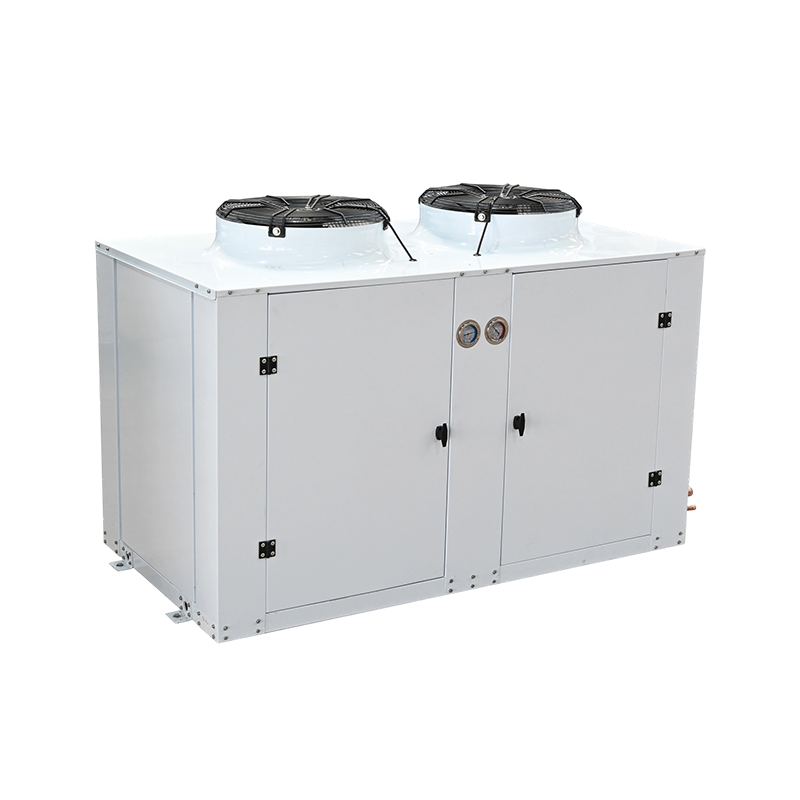 FNU Series Air-Cooled CondenserFinned-tube unit spanning 23.6–51.8 kW, suited to commercial and industrial refrigeration, cold storage, and pharmaceutical or food-processing cooling.View Product →
-
A plant in a 38 °C summer location runs its condensing set point at 45 °C. That leaves an air-coole...
READ MORE -
When a food-processing plant in a water-scarce region evaluates its refrigeration options, the cond...
READ MORE -
What Air-Cooled Condenser and Industrial Air Cooler Technologies Actually Do An Air-Cooled Condense...
READ MORE -
When a food processor plans a new -18°C freezer, the first equipment decision is usually about the ...
READ MORE -
Looking for an affordable, energy-saving alternative to air conditioners for residential, commercia...
READ MORE -
A poultry processor needed 480 kW of condensing capacity for a new ammonia plant room. There was no...
READ MORE

- Email: [email protected]
- Phone: +86-15258555916
- Add: 301 Punan Avenue, Pukou Street, Shengzhou City, Shaoxing City, Zhejiang Province.China
Copyright © Zhejiang Lanxi Refrigeration Equipment Co., Ltd. All Rights Reserved.
浙ICP备2022034605号-1
 Custom Refrigeration Equipment Manufacturers
