
-
 +86-15258555916
-
 [email protected]

 English
 中文简体
 русский
 Tiếng Việt

Refrigeration Unit Guide: Matching Components, Capacity and Site Conditions
Content
- 1 What "Refrigeration Unit" Actually Covers
- 2 The Four Building Blocks and What Each One Decides
- 3 Read Capacity at Your Conditions, Not the Catalogue's
- 4 Screw, Piston or Scroll: Choosing the Compression Type
- 5 Matching the Air Cooler to the Room, Not Just to the Unit
- 6 The Condenser Sets the Head Pressure You Live With
- 7 What to Check Before Approving a Refrigeration Unit Quote
A cold room holds -18 °C perfectly for two weeks, then the coil ices over and the unit trips on high discharge pressure in the middle of a July delivery week. The compressor is usually not the problem. In most of the troublesome installations we are asked about, the fault sits at the boundary between components: an air cooler chosen for a 6 K temperature difference bolted to a condensing unit rated at 10 K, a condenser sized for 32 °C ambient that spends the summer at 41 °C, or a defrost cycle timed for a room that never actually freezes.
The conclusion first: a refrigeration unit is a matched assembly, and it should be judged on the conditions it will really meet rather than the headline capacity on the datasheet. Get the matching right and ordinary components run well for fifteen years; get it wrong and premium compressors fail early. What follows covers what the unit contains, how capacity is actually rated, and which questions separate a solid quotation from an optimistic one.
What "Refrigeration Unit" Actually Covers
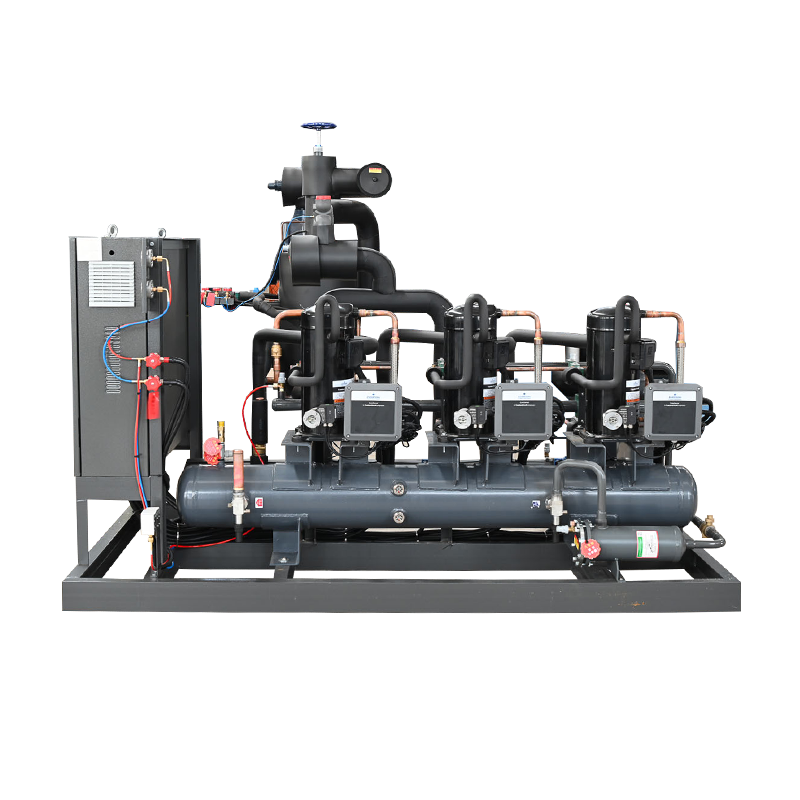
The phrase is used loosely, and that causes real procurement confusion. In commercial and industrial practice it usually means one of three things: a condensing unit (compressor, condenser, receiver and controls on one frame), a compressor unit or parallel rack (two or more compressors sharing suction and discharge headers), or a monoblock and self-contained unit with the evaporator built in.
In all three cases the evaporator, the air cooler inside the room, is frequently quoted separately. That split deserves a written note, because responsibility for the match otherwise sits between two suppliers. Buyers increasingly ask for one system sheet instead of three component sheets, and it helps when the same plant builds the cooler, the condenser and the compressor unit, as is the case with a refrigeration equipment manufacturer working across the full component set.
The Four Building Blocks and What Each One Decides
A vapour-compression unit does one job: move heat from a place you care about to a place you do not. Four blocks do the work, and each one carries a different specification risk.
| Building block | Role in the cycle | First thing to verify |
|---|---|---|
| Compressor | Raises refrigerant pressure and temperature | Capacity at your evaporating and condensing temperature, with refrigerant stated |
| Condenser | Rejects heat to air, water or evaporative spray | Heat rejection at design ambient, airflow or water flow, cleaning access |
| Expansion device | Meters refrigerant into the evaporator | Type (thermostatic, electronic), superheat setting, turndown range |
| Evaporator (air cooler) | Absorbs heat from the room | Temperature difference, fin spacing, defrost method, air throw |
| Receiver and controls | Store liquid, protect the compressor, sequence defrost | Pump-down logic, oil management, alarm outputs, spare parts availability |
Read Capacity at Your Conditions, Not the Catalogue's
Every unit has a nominal capacity, and almost none of that figure will be reached on site. Ratings are published at fixed points, usually an evaporating temperature, a condensing temperature and an entering-air condition, and the same skid can be quoted as 100 kW or 62 kW depending on the point chosen. Three variables do most of the damage: evaporating temperature, condensing temperature and refrigerant.
As evaporating temperature falls, mass flow falls with it and capacity follows downward, while the pressure ratio rises and the compressor works harder for less cooling. The pattern below is indicative rather than a product rating, but the shape holds for any low-temperature unit.
Relative capacity as evaporating temperature falls (design point -25 °C = 100%)
Illustrative pattern only, not a rating for any specific product: a unit stretched to -35 °C delivers roughly two-thirds of what it does at -25 °C, at noticeably higher discharge temperature and oil stress.
The condensing side is the mirror image. A condenser rated at 32 °C ambient loses capacity as ambient climbs toward 40 °C, and if the fan is undersized or the coil is blocked, head pressure rises, capacity drops and power draw climbs at the same time. Refrigerant choice shifts the numbers as well: a move from R404A to a lower-GWP blend such as R448A or R449A changes capacity and pressure drop slightly, and the expansion valve setting normally needs revisiting.
Practical rule: accept a capacity figure only when it arrives with condensing temperature, evaporating temperature, refrigerant, ambient and a tolerance. Around ±5% is normal for a factory rating, and a quote offering one bare number is telling you something about the rest of the document.
Screw, Piston or Scroll: Choosing the Compression Type
Piston compressors remain the default for small and medium loads, for systems that start and stop, and for high pressure ratios where a screw loses efficiency. Screws take over from roughly 100 to 150 kW upward on continuous duty, and slide valve or variable Vi control keeps part-load performance reasonable in a facility that only runs flat out during harvest. Scrolls sit at the small end: compact, smooth, but limited in turndown and rarely repairable in the field.
The decision is less about brand than about load profile. A unit running 6,000 hours a year at 80% load is a different purchase from one peaking four weeks a year. Comparing screw compressor units and piston compressor units really comes down to part-load hours, maintenance access and the cost of a shutdown, not nameplate kilowatts.
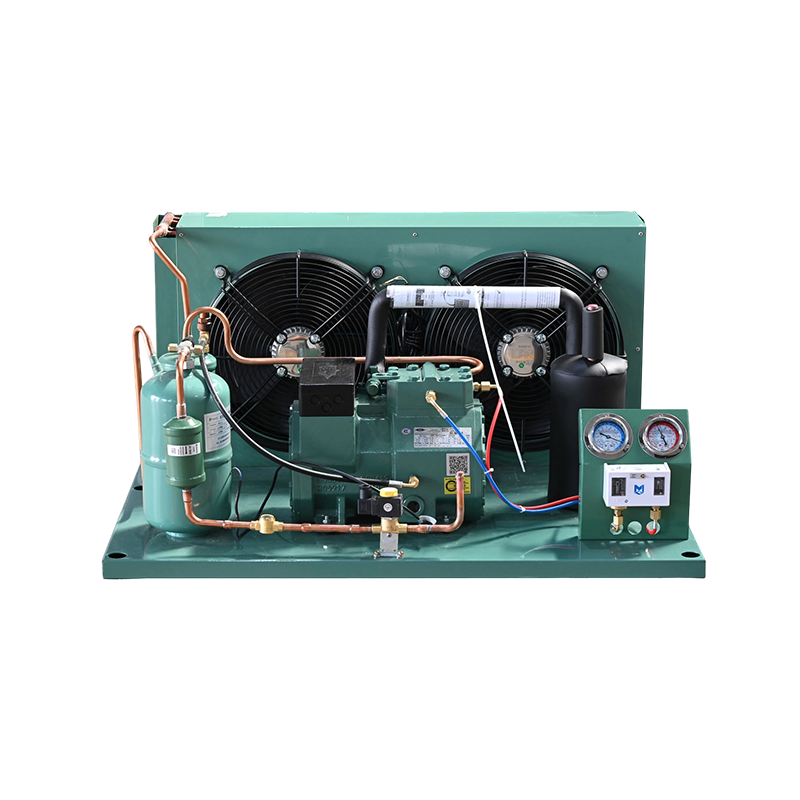 Bitzer Low-Temperature Integrated Refrigeration UnitIntegrated low-temperature refrigeration system with semi-hermetic screw compressors, compact modular layout, and evaporating temperatures down to -40°C for cold storage and food cold chains.View Product →
Matching the Air Cooler to the Room, Not Just to the Unit
The evaporator is where most of the comfort, and most of the trouble, lives. Two numbers decide whether a cooler performs: the temperature difference between room air and evaporating temperature, and the fin spacing.
- A temperature difference of 5 to 7 K suits chill rooms and keeps product weight loss low; 8 to 10 K is common in frozen storage where humidity control matters less.
- Fin spacing of 4.5 mm works for chill rooms above 2 °C, 6 to 7 mm for frozen storage, and 9 mm or more where heavy frosting or constant door opening is expected.
- Defrost choice follows the room: air defrost above roughly 4 °C, electric or hot gas for freezers, water defrost where supply and drainage allow and fast recovery matters.
Undersizing a cooler to save cost raises the temperature difference, dries the room out and lengthens defrost cycles. The unit looks cheaper on the quotation and runs more expensive for a decade. Air throw and fan diameter deserve the same attention, because a cooler that short-circuits its own discharge never sees the room it is meant to cool.
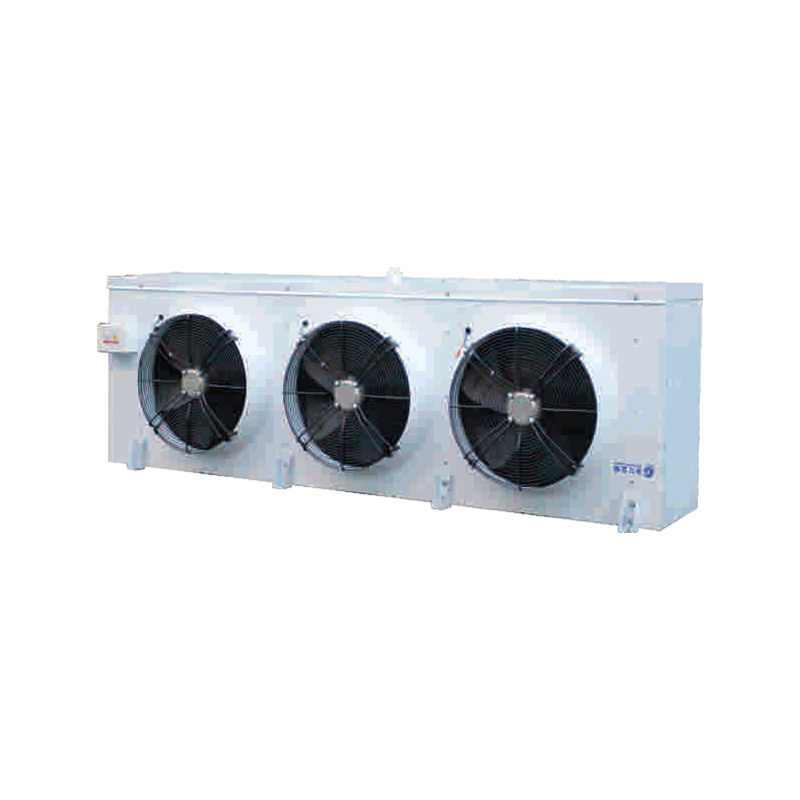 DD Series Cold Room Air CoolerCold-room air cooler for preservation and freezing, with staggered copper-aluminium coils, stainless-steel defrost heaters, and multiple fan and capacity configurations.View Product →
The Condenser Sets the Head Pressure You Live With
Heat rejection is the part of the unit buyers scrutinise least and regret most. The condenser must remove evaporator load plus compressor power, roughly 1.2 to 1.3 times the cooling capacity on low-temperature duty, and it must do so on the hottest afternoon of the year rather than at the 25 °C written into a catalogue table.
Air-cooled condensers are simple and water-free, but lose capacity as ambient rises and need unobstructed airflow and cleaning access; a fouled coil can cost several kelvin of head pressure. Evaporative condensers approach wet-bulb temperature and stay compact, at the price of water treatment, drift control and winter freeze protection. Water-cooled shell-and-tube units are the most stable thermally but depend entirely on water quality and a working tower circuit.
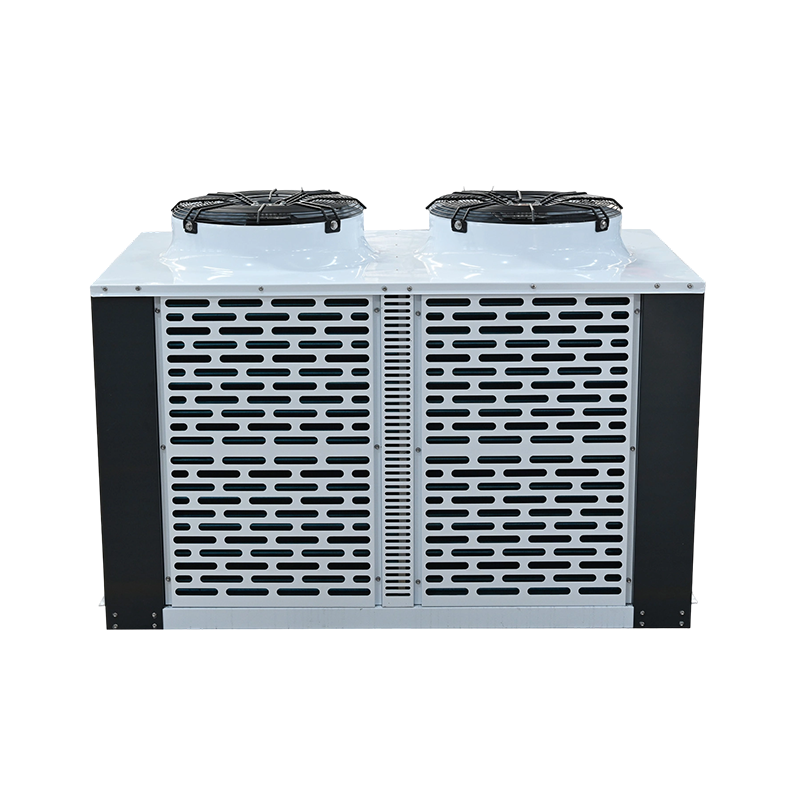 FNV Series High-Efficiency Air-Cooled CondenserAir-cooled condenser with finned heat exchanger, low-noise fans, and corrosion-resistant casing for water-free heat rejection across 23.6–166 kW models.View Product →
What to Check Before Approving a Refrigeration Unit Quote
A short checklist catches most of the expensive surprises, and none of it requires an engineering degree.
- Capacity stated with evaporating temperature, condensing temperature, ambient and refrigerant, plus a tolerance.
- Compressor brand and model spelled out, not just "international brand".
- Condenser heat rejection at your design ambient, with the airflow or water flow that achieves it.
- Air cooler temperature difference, fin spacing, defrost method and fan electrical data.
- Control panel scope: what is included, what the alarm outputs are, and whether defrost and pump-down logic are tested before dispatch.
- Voltage, frequency and refrigerant confirmed against the site, especially for export orders.
- Scope boundaries in writing, so piping, insulation, refrigerant charge and commissioning are clearly one party's job.
- Spare parts list, documentation language and lead time for a replacement compressor.
Two of these items, the rating conditions and the condenser duty, account for more on-site disputes than every other specification combined. Ask for the rating table rather than a single figure, and ask what the unit will do at 40 °C ambient.
A refrigeration unit is a chain of matches: compressor to load profile, evaporator to room, condenser to climate, controls to maintenance reality. When a quotation arrives with a capacity, a brand and a price, the useful next question is not whether it is cheaper, but at which temperatures that capacity was measured. The answer usually settles the rest of the conversation quickly.
-
A cold storage manager in a food plant once called us about a unit that could not pull a 200 square...
READ MORE -
Every summer, the freezer at the far end of a cold storage facility drifts 3-4°C above its -18°C se...
READ MORE -
A dual discharge unit cooler — also known as a double side discharge air cooler, dual-flow evaporato...
READ MORE -
What Is an Industrial Air Cooler and How Does It Work in a Refrigeration System? Picture a medium-s...
READ MORE -
High-quality refrigeration equipment is the core foundation of reliable cooling solutions for moder...
READ MORE -
Industrial thermal management and fluid dynamics demand high-performance architectures capable of ...
READ MORE

- Email: [email protected]
- Phone: +86-15258555916
- Add: 301 Punan Avenue, Pukou Street, Shengzhou City, Shaoxing City, Zhejiang Province.China
Copyright © Zhejiang Lanxi Refrigeration Equipment Co., Ltd. All Rights Reserved.
浙ICP备2022034605号-1
 Custom Refrigeration Equipment Manufacturers
